
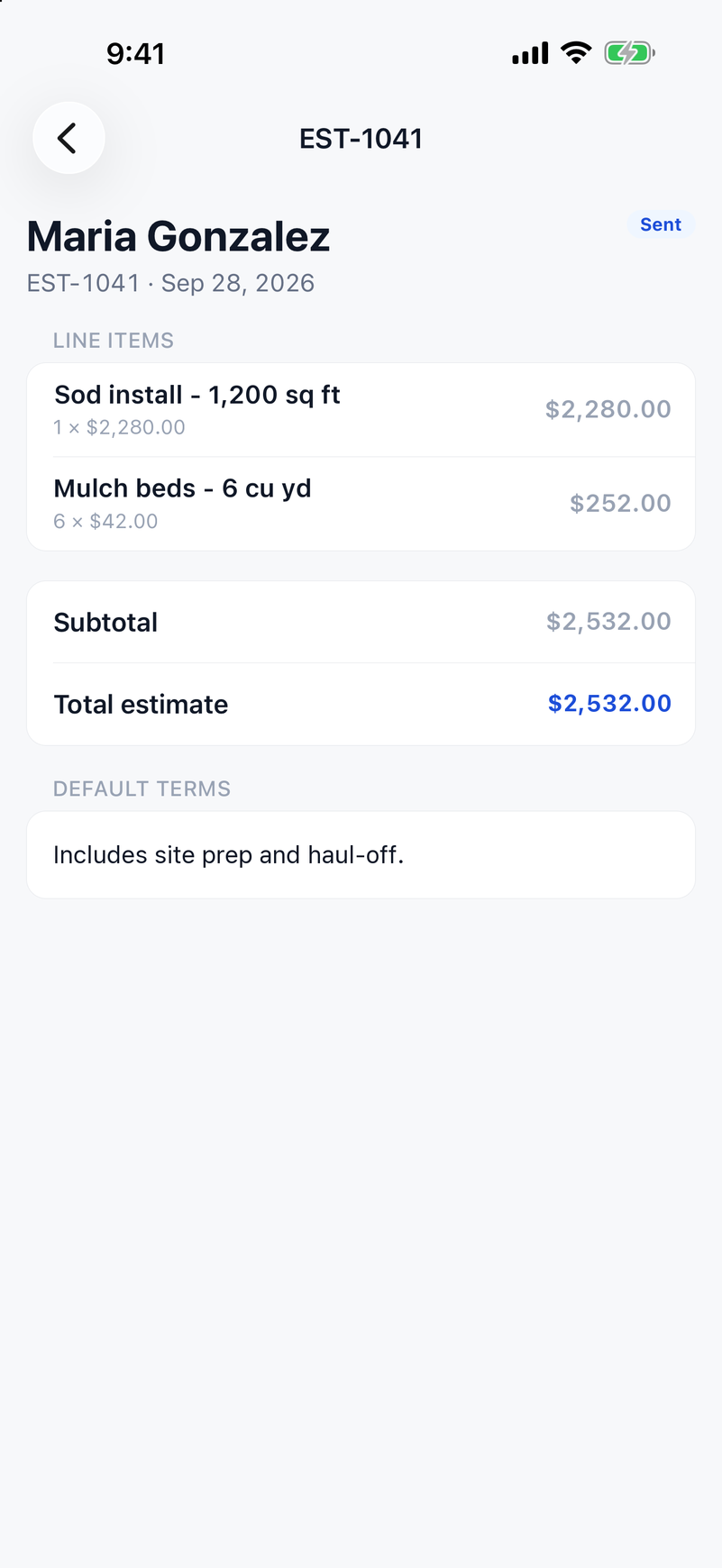
First, the honest part: I'm not a landscaper. I own a cleaning company in Colorado's Vail Valley, and I build ValLedger, software that landscaping and lawn care companies can use to quote, schedule, and invoice. So I won't tell you what grass does in August. What I can tell you is how a service price gets built, because the math under a mowing route and the math under a cleaning route is the same math.
Most "how much to charge for lawn mowing" advice starts with a national average per visit. That number knows nothing about your labor cost, your equipment, or how far apart your stops are. So here's the method instead: build each price from your own costs, then check it against the market.
Start with what an hour of your crew costs
Every landscaping price in this article comes from the same pieces:
Price = (labor hours × loaded hourly cost) + materials + equipment + disposal + overhead share, then add your margin.
Labor hours are person-hours, not clock hours. A two-person crew on a lawn for 30 minutes is one labor hour. Paid drive time counts too.
Loaded hourly cost is the wage plus what the wage costs you: the employer's share of payroll taxes (Social Security and Medicare are 7.65% of wages in the US), unemployment insurance, workers' comp, and any paid time off. If you use subcontractors, their rate is your labor cost.
Equipment means mowers, trimmers, blowers, the trailer, and the truck. Add up a season of fuel, repairs, and replacement set-aside, divide by the hours your crews run, and you have an equipment cost per crew-hour.
Overhead share is everything that keeps the business open whether or not anyone's mowing: insurance, phone, software, marketing, your own time quoting. Divide a month of it by that month's job count.
Margin is profit, and it's not the same thing as markup. A 20% markup on cost is only a 16.7% margin. I covered that trap with worked numbers in the cleaning pricing guide, and it applies here unchanged. The short version: price = total cost ÷ (1 − target margin).
How to price lawn mowing per visit
Mowing is priced per visit because the client wants one number, but the number should come from minutes.
Lot size, measured in minutes
Acreage is a decent first guess and a bad final answer. Two quarter-acre lots can take very different times depending on slope, shape, and how much of the lot is lawn at all. Time the property on the first visit or two and price from the time. If you're bidding one you haven't mowed, walk it and estimate minutes.
Obstacles and trimming
Beds, trees, fence lines, and narrow side yards all add trimming and push-mower time, so a small lot with a lot of edges can take longer than a bigger open one. Quote by lot size alone and you lose money on exactly the properties clients think are "easy."
A worked example
These numbers are illustrative, picked to keep the arithmetic readable. They are not benchmark wages or costs. Swap in your own.
The job: weekly mowing, trim, and blow on an open quarter-acre lot, two-person crew.
- On-site time: 25 minutes × 2 people = 50 labor minutes
- Drive time to the stop: 10 minutes × 2 people = 20 labor minutes
- Labor cost: 70 minutes at an assumed $28 loaded hourly cost = $32.67
- Equipment and fuel per stop: $6
- Overhead share: $8
- Total cost: $46.67
- Price at a 20% margin: $46.67 ÷ 0.80 = $58.33, call it $60 per visit
Same inputs, different properties:
| Property (example) | On-site minutes, 2-person crew | Price at 20% margin |
|---|---|---|
| Open quarter-acre | 25 | $60 |
| Quarter-acre with beds and fence lines | 35 | $70 |
| Open half-acre | 40 | $75 |
| Half-acre with slope and heavy trimming | 60 | $100 |
Each row adds 20 labor minutes of drive time, $6 of equipment and fuel, and $8 of overhead, divides by 0.80, and rounds to the nearest $5.
Now the market check. LawnStarter's 2026 lawn care cost guide puts mowing at roughly $42 to $68 per visit, which is a national figure and moves a lot by region. The example lands inside it for a standard lot. If your formula gives you a number far above your local market, look hard at your minutes, drive time, and overhead. If it comes out far below, you're underpriced and the formula just told you.
The first cut of the season
An overgrown lawn takes longer than the same lawn cut weekly. Price the first cut, or any cut after a skipped stretch, by its actual time, and say so in your terms.
Seasonal and monthly contracts
Many clients would rather pay one steady amount a month. A contract spreads the season's visits into equal payments:
- Weekly mowing at $60 a visit (the example above)
- An assumed season of 28 weekly visits
- 28 × $60 = $1,680 for the season
- Spread over the 7 months you mow: $240 a month
- Spread over 12 months: $140 a month
LawnStarter's same guide puts average monthly lawn care at roughly $100 to $410, again a national range that varies by region and by what's included.
Before you offer the 12-month option, run the cash flow. By the end of the mowing season you've delivered $1,680 of work and collected $980. The client owes you the rest in the months you're not there. That can work with clients you trust, but put the cancellation terms in writing: if they cancel mid-contract, they pay for the visits delivered, not the payments made.
Three things belong in every lawn contract:
- The number of visits and the frequency. "Weekly from April through October, 28 visits" is a contract. "Lawn care" is an argument waiting to happen.
- What happens in drought and in wet weeks. A fixed monthly price averages out skipped dry weeks and extra wet ones. Say whether skipped visits are credited or not.
- What's not included. Cleanups, aeration, fertilization, and bed work are usually separate, quoted jobs.
Spring and fall cleanups
Cleanups are where hours are hardest to see in advance. Leaves, branches, and cut-back perennials vary wildly by property. Price them by time, plus the cost of getting rid of what you pick up. Walk the property, estimate a range of crew hours, and quote that range at your hourly rate with an estimated total. Then add disposal as its own line. Dump and green-waste fees are real money, and they're the cost that disappears first when it's buried in a lump sum. I made the same point about invoices in the landscaping invoice template, and it's even more true at the quoting stage.
Mulch, sod, and planting installs
Installs follow the same formula with more of the cost in materials, equipment, and disposal. Every install estimate should account for four things separately: materials, labor, equipment, and disposal.
A worked sod example
Illustrative numbers again: a 1,200 sq ft sod install that includes removing the old turf.
- Sod: 1,260 sq ft (1,200 plus about 5% for cuts and waste) at an assumed $0.50 per sq ft = $630
- Delivery: $100
- Labor: 3 people × 8 hours = 24 labor hours at $28 = $672
- Equipment: sod cutter and tiller rental = $150
- Disposal: hauling off the old turf, dump fees included = $180
- Overhead share: $90
- Total cost: $1,822
- Price at a 20% margin: $1,822 ÷ 0.80 = $2,277.50, call it $2,280, or $1.90 per sq ft
That's the sod line in the screenshot at the top of this post. For a market check, Homewyse's sod installation calculator showed a national range of about $2.20 to $3.68 per sq ft in September 2026, including site prep and cleanup, and it adjusts by zip code. My example comes in under that range. In a real business, that's the moment to ask whether the labor hours or the overhead were too thin before you send the quote.
Mulch
Mulch is usually quoted per cubic yard installed: the material, a share of the delivery, the labor minutes to spread it, and any edging or weed prep. Time how long your crew takes to spread a yard, and you can price any mulch job by multiplying.
Planting
Plants can die, and if you warranty them, that risk is a cost. Price the plant, the labor to install it, and a share of the replacements you expect, and write the warranty terms and exact plant specs (species, container or caliper size) on the estimate.
Per square foot or per job?
Square footage is a good way to describe a price and a poor way to calculate one.
For sod, mulch, and other installs, a per-square-foot or per-cubic-yard rate works once you know your own production rate, meaning how many square feet or yards your crew installs per labor hour. Until then, build the job from hours and divide by square footage at the end if the client wants that number.
For mowing, price per visit. The client cares about the weekly number, not your rate per square foot.
Minimums, fuel, and drive time
Set a minimum charge
Every stop costs you the drive, the unload, and the reload before a blade turns, even on a lot that takes 10 minutes to mow. A minimum charge per visit covers that: drive time, unload time, and the stop's share of equipment and overhead, plus your margin. Below that number, you're paying to work.
Route density is a pricing decision
Drive time is labor you pay for and can't bill by the hour. A client 25 minutes off your route costs you more than one on a street with three others. Either price the distance in, with a higher per-visit rate outside your core area, or decline work far out of the way. What doesn't work is quoting a far-out client the same as a neighbor and eating the difference all season.
Fuel belongs in equipment cost per crew-hour. It moves during a season, and a contract price doesn't, so check it every time you rerun your numbers.
How to raise your prices
Wages, insurance, equipment, and dump fees go up every year. A price you never touch is a pay cut you gave yourself.
- Rerun the formula every year before the season. Use this year's wages, equipment, and overhead. If the result is higher than what you charge, that's your increase.
- Change prices at contract renewal. Seasonal work gives you a natural moment. New season, new agreement, new rate.
- New clients first. Quote new clients at the new rate right away. It tells you whether your market accepts it.
- Give existing clients written notice. The new rate, the date it starts, and one sentence on why. A modest increase every year is easier to accept than a big jump after three flat ones.
Where ValLedger fits
Here's how this pricing turns into estimates and schedules in ValLedger.
Price book. You save your services once, each priced flat, hourly, or per unit with a unit label, so mulch can be priced per cu yd and sod per sq ft. When you build an estimate on the web or in the phone app, you pull items from the price book instead of retyping prices.
Three estimate types:
- Service is one service at a flat price or an hourly rate. In hourly mode you can enter a minimum and maximum number of hours, and the client sees that range with an estimated total. That's the cleanup quote from above.
- Itemized is a list of line items, each with a quantity and rate. That's the install estimate: sod, mulch, equipment, and disposal as separate lines.
- Flat Rate lists what's included and shows the client one price. It can be one-time or per week, month, quarter, or year. A seasonal contract goes here as a monthly price with the visits and scope listed under it. There's no separate "seasonal" setting. You set the monthly price and spell out the season in the scope.
Recurring jobs. Jobs can repeat weekly, every other week, or monthly, and you can cap a series with an end date, which is how you'd stop a weekly mowing series at the end of the season.
Route optimization. For a given day, the route optimizer reorders the stops to cut driving. Jobs with appointment times stay in time order, the rest go wherever they add the least driving, and you see the new order's distance and drive time against the current one before you apply it.
Pay per visit. If you pay crew by the stop instead of by the hour, you can set a fixed pay amount on a client's location. A worker who clocks in there is paid that amount once for the day instead of hourly.
Deposits and approval. You can require a deposit on an estimate, as a percentage or a fixed amount. The client opens the estimate in their client portal, approves it, and signs on screen. The deposit is paid by card when you've connected online payments through Stripe. On install work where you're buying sod and plants up front, that matters.
There's more on the landscaping software page, including invoicing and scheduling.
The short version
Work out your loaded labor cost, equipment cost per crew-hour, and overhead per job. Price mowing from minutes on site and minutes driving. Spread the season's visits into contract payments and put the visit count in writing. Price cleanups by hours plus disposal, and installs from materials, labor, equipment, and disposal. Set a minimum. Rerun the numbers before every season.
When you want your price book, estimates, recurring jobs, and routes in one place, you can try ValLedger free for 14 days, no credit card required, and price a real week of jobs with it before you decide.